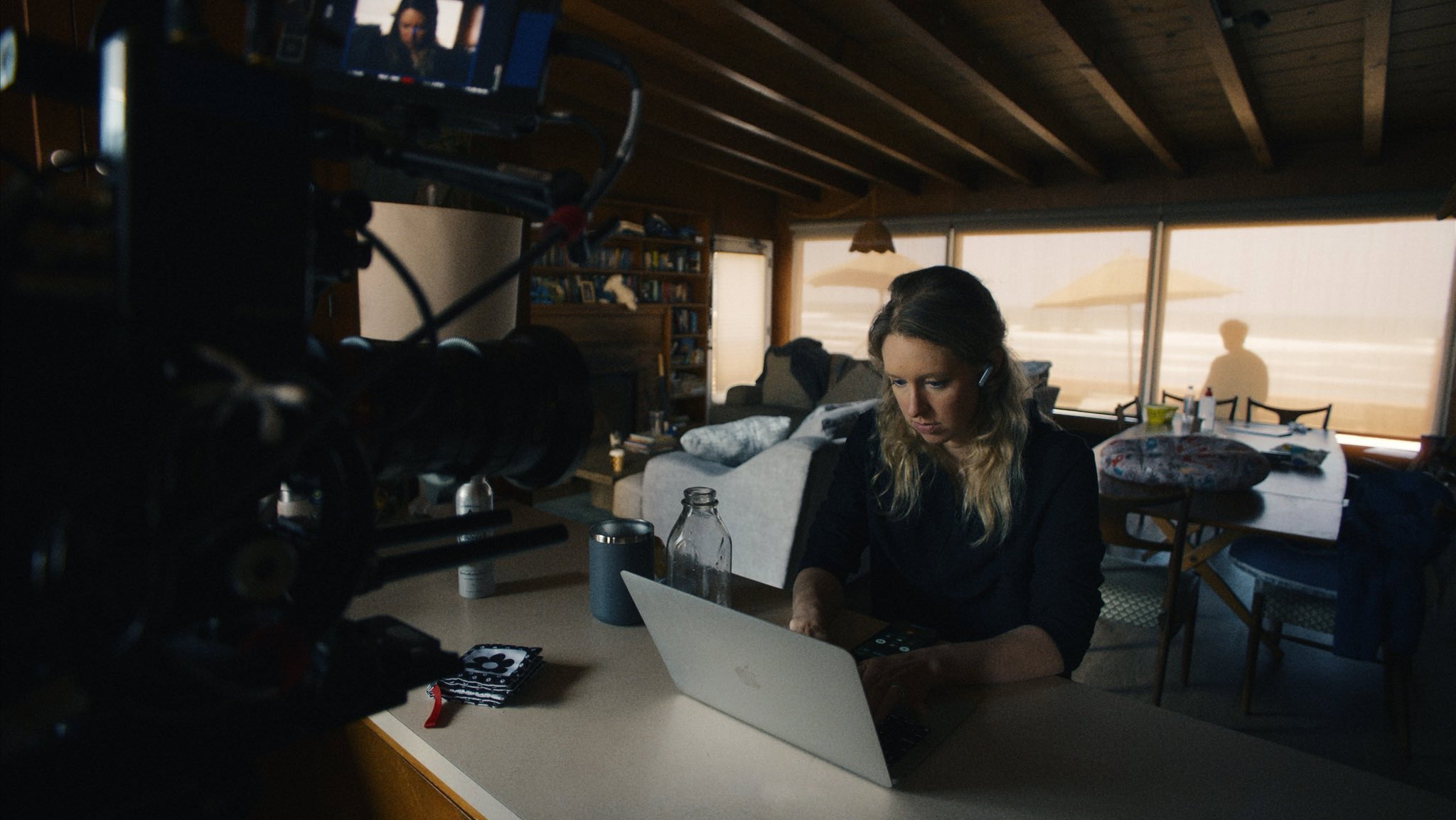
Last night I made the time to watch one of the most acclaimed documentaries of the decade, You Can See Everything from Nathan Fielder and Lance Oppenheim. The documentary’s premise is that the crew has been invited to document the last weeks of freedom for Elizabeth Holmes, who was convicted of defrauding investors through her healthcare company Theranos. The unique layer is that Nathan Fielder isn’t a traditional journalist, but more of a surrealist comedian whose most recent work pokes and prods at the concept of artifice in “reality-based” media.
This post won’t get into the second part of this movie which reviewers and audience members are trying to keep spoiler-free from the uninitiated. What I will say is that I actually don’t think the alleged turning point of this movie is all that game-changing, especially for someone who’s seen Fielder’s television show, The Rehearsal. You can know the details of what happens in the second half of YCSE and still be taken in by the plot and the filmmaking. Still, we won’t discuss it here.
I want to make a note of a specific scene in the first half. There’s a montage of Holmes and her partner, Silicon Valley startup-bro Billy Evans, animatedly speaking to at least one investor to raise funds for their next business venture, which is yet another medical diagnostic company purportedly built on “revolutionary” technology. After the montage, you get a short scene of Holmes dressed up for a run and looking honestly as thrilled and elated as you ever see her. She says something along the lines of “I feel so alive” and “[that’s] what I was put on this planet to do.”
Subsequently, she starts to reconcile how she can do the technology venture from the realities of prison. She talks about sketching notes and diagrams on napkins and showing them to Billy for his regular prison visits. She’s really focused on how she needs to constantly be “inventing.”
Scenes like these unlocked part of the mystery of Elizabeth Holmes for me. Because there’s a fundamental tension of the movie compelling the audience to question whether Holmes is consciously lying to other people or always lying to herself. (The third option – that she’s the victim of other people’s lies and is fundamentally an honest person doesn’t seem to merit much scrutiny).
And seeing her get jazzed, not about any breakthroughs in medical science or positive impact of her work – but from pitching to someone with money and getting them on board an idea with the slimmest chance of success – made me recognize her. “Oh. She has LinkedIn brain.”
I was describing this to my wife when I got home, who was blissfully unaware of the concept. LinkedIn Brain is the person who views the mechanisms of knowledge work and career advancement in the age of the Internet as the highest of priorities. Whereas the average worker reports to their job and might get some satisfaction out of actually doing things well or simply endures demands on their time for a paycheck, the LinkedIn Sycophant, infected with the mold of entrepreneurial flim flam that has bolstered Bill Gates, Steve Jobs, and Elon Musk, is very intent on crafting and experiencing a narrative of hyper success.
Holmes has a lot of social quirks and the movie gestures at some potential trauma that might inform how she operates. So there’s moments that again allude to Fielder’s previous work that start to call into question whether Holmes is neurodivergent and thus has a different relationship to communicating than most in the audience. But to me it’s not as interesting to question whether she is uniquely wired for dishonesty. I think the most interesting scenario is one in which she is like many other “regular people” who are fully bought-in to a story inspired by the myths of entrepreneurial giants.
Holmes is not a scientist. She’s not an executive. She’s not even necessarily the most gifted fundraiser or diviner of the markets. She’s a storyteller, just as Nathan Fielder is. She feels most alive when she can tell a story on her terms.
So she can’t be explained as a singular monster whose work, had it continued unchecked, would have led to actual death and medical mayhem. (As far as I know, the only death that can currently be linked to Theranos is one of the lead scientists who committed suicide before his deposition). The chilling idea is that there are millions of Elizabeth Holmes’s on the world’s most popular professional social network whose harbored wish is to fulfill a destiny of career revolution. The facts at the center of their career trajectory are malleable. It’s not really important what happens as long as they are the ones who come out as the successful protagonists.
It is kind of a horror movie, isn’t it?
LinkedIn Brain and “You Can See Everything”
Leave a Reply