Project Hail Mary (2021)

Excellent plotting. Side-eye narration.
I wanted to see the movie and my father-in-law had the book to lend. Andy Weir has a gimmick about making his scientist protagonists relatable to the point of not being a person with recognizable interiority. His protagonists in this book and in The Martian think in their private mind the way I believe other people pretend to be in social functions. But I don’t think any human actually thinks this way.
That said, I very much enjoyed this and would take this over the Dungeon Crawler Carl craze happening at the moment. Weir has an excellent sense of tension and stakes in the progression of the plot. He could write some of the greatest sci fi of our era if those moments didn’t come with a “well, that happened” punctuator.
Dirk Gently’s Holistic Detective Agency (1987)
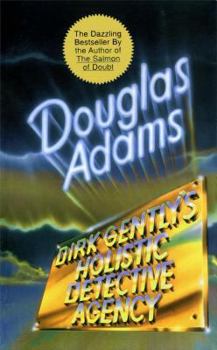
The most relevant anti-AI book of our time.
I’m a big Hitchhiker’s Guide fan, having enjoyed my first exposure to proper satire during my lonely middle school days and then discovering over time that almost everyone I liked to interact with had a similar experience.
I’d known about Dirk Gently in theory, but it wasn’t until our book club selected it that I had a chance to read any non-Hitchhiker’s books from Douglas Adams.
The core wit is there and refreshing in how deftly it’s weaved in with a denser plot. Our club had the consensus that the density of jokes is far fewer than the most well-known parts of the Hitchhiker’s series and while I’m a little neutral on how the central mysteries involving the Electric Monk and Gordon Way are handled, one of Adams’ messages resonated with me.
He warned us to not get super reliant on technology and use tremendous amounts of resources to do basic tasks of living.
Dirk Gently’s Holistic Detective Agency is an anti-artificial intelligence book written 40 years before the explosion of generative AI and LLMs.
How timely. I’ll read it again.
Escape! (2026)

Fishbach’s best move since pairing up with Jeremy in Cambodia
Coinciding with a return to a Survivor era of my life, I received this book a couple months into 2025 after pre-ordering it last year. I rarely pre-order books, but Stephen Fishbach promised me more “Blood on the Clocktower” YouTube videos if I did that, but as the show that popularized him taught me: trust nobody.
I can praise Escape! as being a page-turner. Fishbach commits to escalation of plot and introduces a varied enough cast of characters with potential arcs you’ll want to see close out, much like Survivor does. He has flashes of damn good writing, particularly in the final act when his characters are really pushed into moments of existential reflection.
But it’s important to see this as something of an absurdist plot and I wonder how it will play to people who haven’t been following pop culture discussion of “the edit” or even to fans of reality TV that don’t follow survival shows. At times it feels like Fishbach gave in to a thought exercise and the conclusion feels like something unearthed rather than purposefully crafted. Still, a good airplane read, as I made significant progress on my five-hour flight from California to North Carolina.
Wuthering Heights (1847)

I’d like to see the full adaptation, please.
I feel like I was told this would not be the stodgy 19th century romance that I expected, but I was still surprised at how much Bronte was committed to writing bad people who do bad things.
I do think my experience was helped by still finding ounces of sympathy for Heathcliff, Catherine the elder, and all of them. Even Joseph. Bronte excelled at setting up the internal motivations and the traumatic experiences that built these people up to act as they do.
I was a little harangued by the narration model and I didn’t care to see the world through Lockwood’s eyes at the beginning. Thankfully, the narrator MVP is Nelly Dean, who I think should have started and ended the whole thing.
Leave a Reply